PFAS have been used in many household and industrial products because of their stain- and water-repellent properties. PFAS are now present virtually everywhere in the world because of the large amounts that have been manufactured and used. Once these compounds are released, many of them tend to stay in the environment for a very long time.
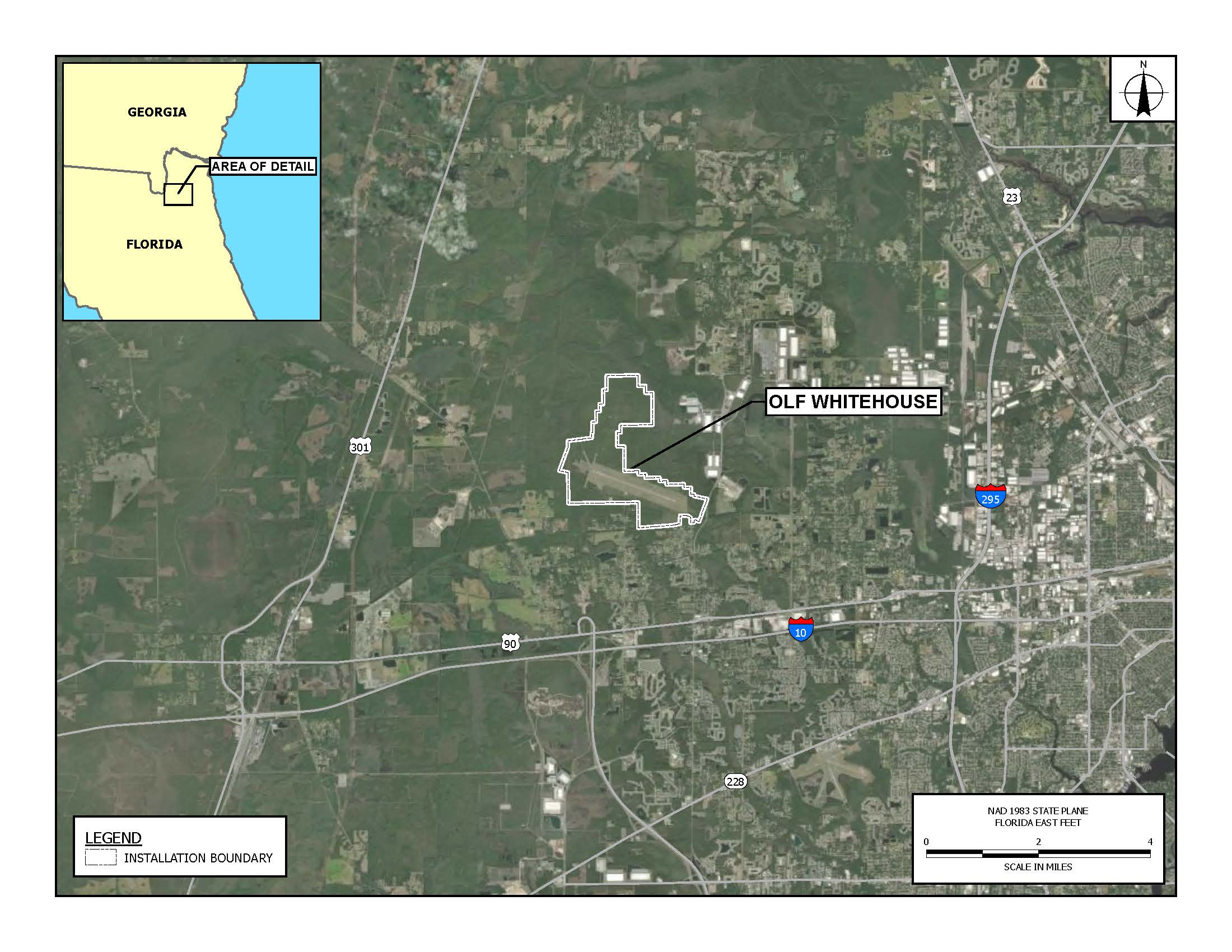
The most common activity that could have resulted in the historical release of PFAS to the environment at OLF Whitehouse (Figure 1) is the use of firefighting foam (specifically, aqueous film-forming foam, or AFFF). Due to this historical use, PFAS are present in the groundwater on base and previously warranted the evaluation of nearby private drinking water wells located in the direction that the groundwater flows away from the base.
On April 26, 2024, the United States Environmental Protection Agency (EPA) published a National Primary Drinking Water Regulation (NPDWR) establishing nationwide drinking water standards for certain PFAS under the Safe Drinking Water Act. The regulation applies to public drinking water systems. Operators of public drinking water systems regulated by the NPDWR have until April 26, 2029 to meet these standards. In September 2024, the Department of War (DoW) published “Prioritization of Department of Defense Cleanup Actions to Implement the Federal Drinking Water Standards for Per- and Polyfluoroalkyl Substances under the Defense Environmental Restoration Program,” which describes DoW’s plans to incorporate the EPA’s drinking water regulation into DoW’s ongoing PFAS cleanups and prioritize actions to address private drinking water wells with the highest levels of PFAS from DoW activities. Table 1 shows DoW PFAS Interim Action Levels for Private Drinking Water Wells and EPA NPDWR Levels.
Table 1 presents the DoW PFAS Interim Action Levels for Private Drinking Water Wells (DoW 2024) and EPA NPDWR Levels. The DoW’s September 2024 memorandum can be found here.
Table 1: EPA NPDWR Levels for Public Water Systems and DoW PFAS Interim Action Levels for Private Drinking Water Wells
| PFAS |
EPA NPDWR Level for Public Water Systems |
DoW PFAS Interim Action Level for Private Drinking Water Wells1 |
| perfluorooctanoic acid (PFOA) |
4 ppt |
12 parts per trillion (ppt) |
| perfluorooctane sulfonic acid (PFOS) |
4 ppt |
12 ppt |
| perfluorononanoic acid (PFNA) |
10 ppt |
30 ppt |
| perfluorohexane sulfonic acid (PFHxS) |
10 ppt |
30 ppt |
| hexafluoropropylene oxide dimer acid (HFPO-DA, or GenX) |
10 ppt |
30 ppt |
| hazard index for mixture of at least two of PFHxS, PFNA, HFPO-DA, and perfluorobutane sulfonic acid (PFBS) |
1 (no units) |
3 (no units) |
ppt = part(s) per trillion
1 These levels are based on current EPA NPDWR levels. If EPA updates applicable requirements, DoW will review and update its policy as appropriate.
PRIVATE DRINKING WATER WELL SAMPLING NEAR OLF WHITEHOUSE
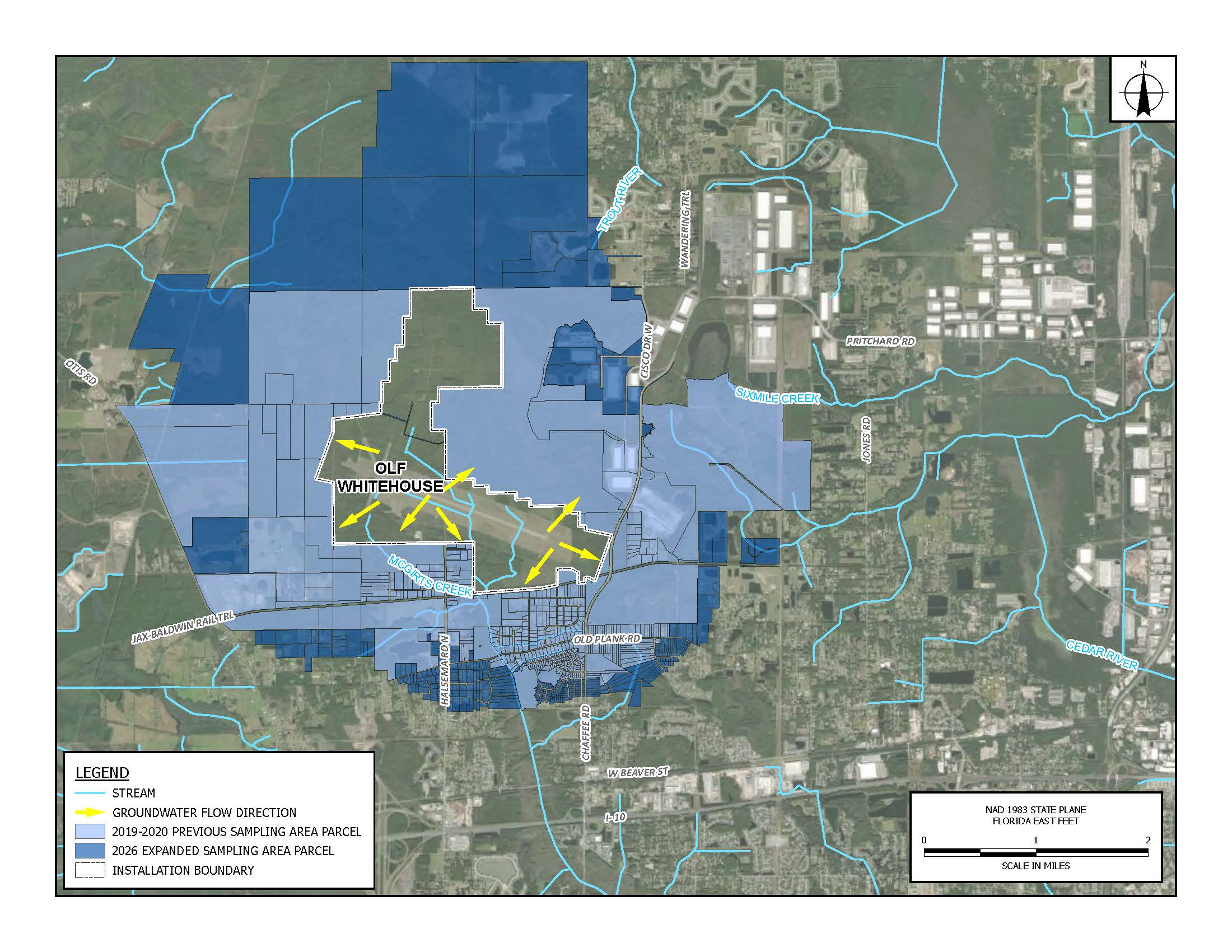
Certain PFAS have been detected in groundwater at OLF Whitehouse. As a result of the detections at OLF Whitehouse, a sampling area (Figure 2) was established 1 mile in the direction that groundwater flows away from the locations of these detections.
2026 PRIVATE DRINKING WATER WELL SAMPLING
At this time, the Navy is requesting property owner permission to sample private drinking water wells in the sampling area near OLF Whitehouse (Figure 2). Due to improvements in laboratory methods, the Navy is also requesting property owner permission to resample private drinking water wells that were sampled by the Navy in 2019 and 2020. If your drinking water is provided by the Jacksonville Electric Authority, the Navy does not need to sample your drinking water.
The samples will be sent to an accredited, independent laboratory. The laboratory will analyze for the presence of certain PFAS according to EPA-approved methods. The laboratory will then provide the Navy with preliminary results, after which the preliminary results will be validated by an independent third-party for quality assurance. Once the results are validated, they will be provided to property owners and tenants, approximately 3 months after sampling.
Figure 2 - Sampling Areas
PREVIOUS 2019 - 2020 PRIVATE DRINKING WATER WELL SAMPLING
Beginning in 2019, the Navy sampled private drinking water wells based on information that was available at that time about PFAS releases at OLF Whitehouse. The 2019 to 2020 sampling area, shown on Figure 2, was established 1 mile in the direction that groundwater flows away from a known release area. Table 2 provides a summary of the results of the sampling. None of the properties sampled had detections of PFOA and/or PFOS above 70 ppt, the Navy’s action level at the time. Table 3 presents the PFAS results.
Table 2: OLF Whitehouse – 2019 - 2020 Private Drinking Water Well Results Summary
| Year |
Number of Wells Sampled |
Number of wells with no detections of PFAS with DoW PFAS Interim Action Levels for Private Drinking Water Wells |
Number of wells with detections of PFAS below the EPA NPDWR Levels |
Number of wells with detections of PFAS below the DoW PFAS Interim Action Levels for Private Drinking Water Wells above the EPA NPDWR Levels |
Number of wells with detections of PFAS at or above DoW PFAS Interim Action Levels for Private Drinking Water Wells and PFOA and/or PFOS below 70 ppt* |
Number of wells with detections of PFOA and/or PFOS above 70 ppt* |
| 2019-2020 |
152 |
121 |
31 |
0 |
0 |
0 |
*70 ppt for PFOA and PFOS, individually or combined, was the Navy’s action level at the time of this sampling.
The Navy has reevaluated the 2019 to 2020 private drinking water well results using the current DoW PFAS Interim Action Levels for Private Drinking Water Wells. None of the private drinking water wells sampled near OLF Whitehouse contain PFAS at or above these levels.
Table 3: OLF Whitehouse – 2019 - 2020 - Private Drinking Water Well Results
| Sample1 |
PFOA (ppt) |
PFOS (ppt) |
PFOA+PFOS2 (ppt) |
PFNA (ppt) |
PFHxS (ppt) |
HFPO-DA (ppt) |
PFBS (ppt) |
Hazard Index3 |
| 1-117 |
ND |
ND |
ND |
ND |
ND |
ND |
ND |
NC |
| 118 |
ND |
ND |
ND |
ND |
ND |
ND |
0.25 J |
NC |
| 119 |
ND |
ND |
ND |
ND |
ND |
ND |
0.17 J |
NC |
| 120 |
ND |
ND |
ND |
ND |
ND |
ND |
0.23 J |
NC |
| 121 |
ND |
ND |
ND |
ND |
ND |
ND |
0.82 J |
NC |
| 122 |
0.41 J |
ND |
0.41 |
0.21 J |
ND |
ND |
ND |
0.02 |
| 123 |
1 J |
0.39 J |
1.39 |
ND |
1.81 J |
NA |
1.46 J |
0.18 |
| 124 |
0.76 J |
0.48 J |
1.24 |
ND |
1.36 J |
NA |
0.93 J |
0.14 |
| 125 |
0.3 J |
ND |
0.3 |
ND |
ND |
ND |
ND |
NC |
| 126 |
ND |
0.49 J |
0.49 |
ND |
ND |
ND |
ND |
NC |
| 127 |
1.89 J |
0.26 J |
2.15 |
ND |
0.95 J |
ND |
1.08 J |
0.10 |
| 128 |
ND |
0.17 J |
0.17 |
ND |
0.28 J |
ND |
ND |
NC |
| 129 |
0.88 J |
0.41 J |
1.29 |
ND |
1.68 J |
ND |
1.13 J |
0.17 |
| 130 |
1.13 J |
0.36 J |
1.49 |
0.12 J |
ND |
ND |
0.14 J |
0.01 |
| 131 |
ND |
0.28 J |
0.28 |
ND |
ND |
ND |
ND |
NC |
| 132 |
ND |
0.14 J |
0.14 |
ND |
0.24 J |
ND |
ND |
NC |
| 133 |
ND |
ND |
ND |
ND |
0.2 J |
ND |
ND |
NC |
| 134 |
ND |
ND |
ND |
ND |
0.15 J |
ND |
ND |
NC |
| 135 |
0.76 J |
ND |
0.76 |
ND |
1.09 J |
ND |
0.12 J |
0.11 |
| 136 |
ND |
0.21 J |
0.21 |
ND |
ND |
ND |
ND |
NC |
| 137 |
ND |
0.21 J |
0.21 |
ND |
ND |
ND |
ND |
NC |
| 138 |
0.36 J |
0.17 J |
0.53 |
ND |
ND |
ND |
ND |
NC |
| 139 |
1.22 J |
0.58 J |
1.8 |
ND |
2.19 J |
ND |
1.52 J |
0.22 |
| 140 |
ND |
0.15J |
0.15 |
ND |
ND |
ND |
ND |
NC |
| 141 |
0.56 J |
ND |
0.56 |
ND |
ND |
ND |
ND |
NC |
| 142 |
0.2 J |
ND |
0.2 |
ND |
ND |
ND |
ND |
NC |
| 143 |
0.23 J |
ND |
0.23 |
ND |
ND |
ND |
ND |
NC |
| 144 |
0.23 J |
ND |
0.23 |
ND |
0.26 J |
ND |
0.15 J |
0.03 |
| 145 |
ND |
ND |
ND |
ND |
0.3 J |
ND |
ND |
NC |
| 146 |
0.36 J |
0.21 J |
0.57 |
ND |
0.16 J |
ND |
0.18 J |
0.02 |
| 147 |
ND |
0.15 J |
0.15 |
ND |
ND |
ND |
ND |
NC |
| 148 |
0.19 J |
ND |
0.19 |
ND |
ND |
ND |
ND |
NC |
| 149 |
3.17 |
ND |
3.17 |
0.11 J |
4.11 |
ND |
4.8 |
0.42 |
| 150 |
ND |
ND |
ND |
ND |
1.29 J |
ND |
0.56 J |
0.13 |
| 151 |
0.37 J |
ND |
0.37 |
ND |
ND |
ND |
ND |
NC |
| 152 |
ND |
0.14 J |
0.14 |
ND |
ND |
ND |
ND |
NC |
1Displays the highest detected value of each PFAS analyte shown on this table per drinking water well sampled. Sample numbers demonstrate the samples that have been collected but each number does not correspond to a specific property.
2For any drinking water wells with PFOA and/or PFOS individually or combined above 70 ppt, the Navy can provide bottled water for drinking and cooking until a more enduring solution is implemented.
3HI = Hazard Index. Calculated for HFPO-DA, PFBS, PFNA, and PFHxS when two or more of these compounds are detected in the sample. Calculated per EPA recommendations (Maximum Contaminant Level Goals (MCLGs) for Three Individual Per- and Polyfluoroalkyl Substances (PFAS) and a Mixture of Four PFAS, 2024) as follows:
Hazard Index (unitless) = (HPFO-DA (ppt) / 10 (ppt)) + (PFBS (ppt) / 2000 (ppt)) + (PFNA (ppt) / 10 (ppt)) + (PFHxS (ppt) / 10 (ppt))
PFOA+PFOS is only calculated when both are detected.
NC = not calculated
ND = not detected
J = Result is estimated
ppt = parts per trillion
ACTIONS BASED ON PRIVATE DRINKING WATER SAMPLING RESULTS
The preliminary results from the private drinking water well sampling are expected approximately 30 days after collecting the samples. The Navy will provide notification to the property owners and tenants of their drinking water results and any follow-up actions, if needed.
The Navy will address PFAS in private drinking water wells in keeping with the DoW policies:
PFAS at or above the DoW PFAS Interim Action Levels for Private Drinking Water Wells (Table 1). The Navy will work with property owners to implement an enduring solution as soon as possible. Options for enduring solutions may include connection to public water or installation of a drinking water treatment system. For any drinking water wells with PFOA and PFOS, individually or combined, above 70 ppt, the Navy can provide bottled water for drinking and cooking to property owners or tenants until a more enduring solution is implemented.
For final remedial actions, the Navy will address PFAS in private drinking water wells down to EPA NPDWR levels or background levels in accordance with Comprehensive Environmental Response, Compensation, and Liability Act (CERCLA) requirements.
IDENTIFICATION OF PFAS RELEASES AT NAS WHITING FIELD
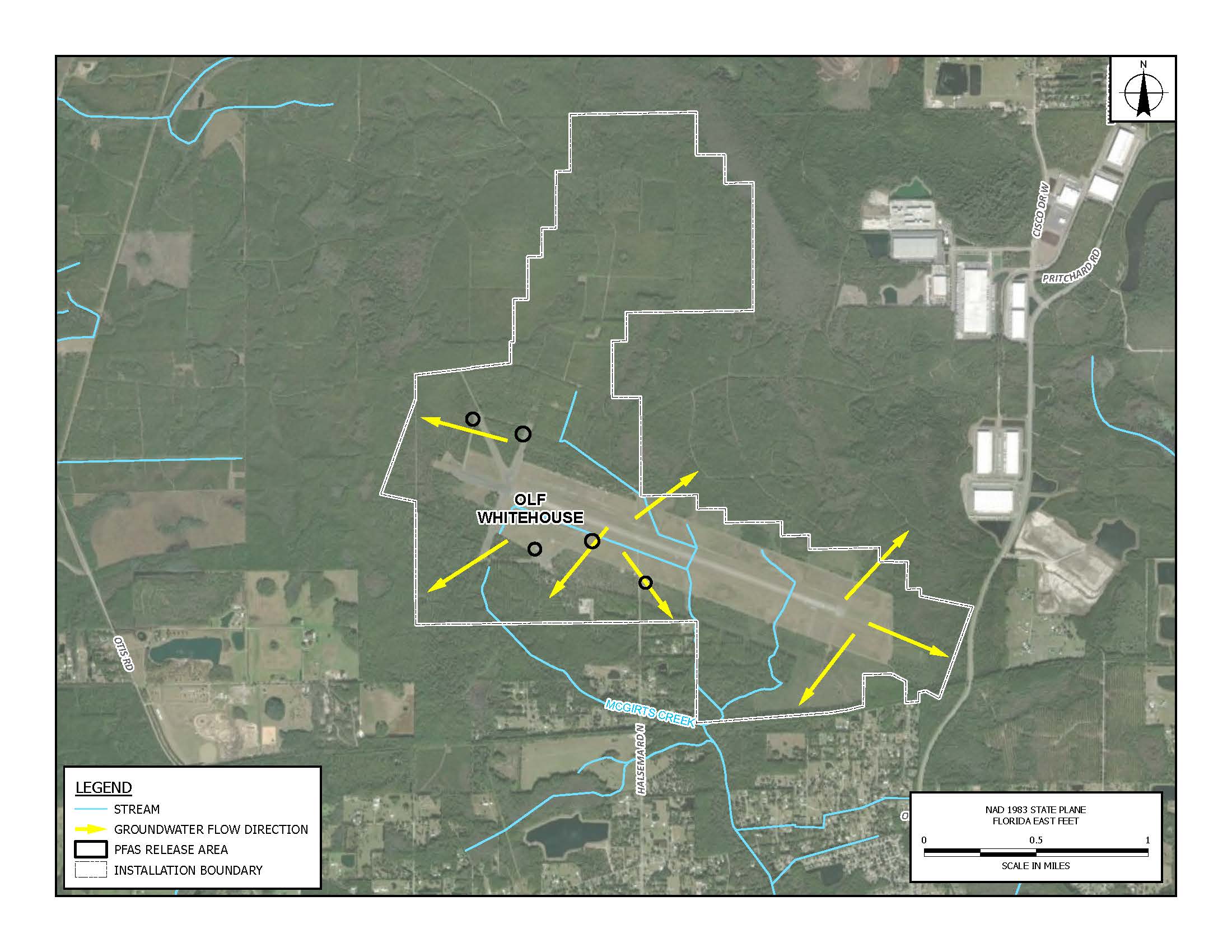
The Navy finalized a PFAS Preliminary Assessment (PA) in 2020 that identified areas where releases of PFAS may have occurred. Based on the results of the PFAS PA, the Navy completed a PFAS Site Inspection (SI). Sample collection and analyses of soil and groundwater were conducted from March 2019 to October 2020. PFAS were found in groundwater and soil at OLF Whitehouse. The PFAS release areas investigated at OLF Whitehouse are listed below and shown on Figure 3. Remedial investigations are ongoing at the following release area:
- Former FFTA
- Newer FFTA
- DLA-DS, formerly named DRMO (OU 7, PSC 46)
- Domestic sludge drying beds
- East Hush House, Building 770
The Navy will continue investigating PFAS at OLF Whitehouse following the CERCLA process and will evaluate if actions are needed. To find out more about all of the environmental investigations at OLF Whitehouse, visit https://www.navfac.navy.mil/NASJax.
Figure 3 - PFAS Release Areas at OLF Whitehouse
OLF WHITEHOUSE PRIVATE DRINKING WATER WELL SAMPLING DOCUMENTS - CURRENT INVESTIGATION
OLF WHITEHOUSE PRIVATE DRINKING WATER WELL SAMPLING DOCUMENTS - PREVIOUS INVESTIGATIONS
ADDITIONAL DOCUMENTS
LINKS