La Marina y el Cuerpo de Infantería de Marina solicitan permiso a los propietarios para tomar muestras de pozos privados de agua potable dentro de una zona de muestreo cercana a la Base Logística de la Infantería de Marina (MCLB, por sus siglas en inglés) en Barstow, con el fin de detectar sustancias perfluoroalquílicas y polifluoroalquílicas, o PFAS.
|
Los propietarios que tengan un pozo de agua potable en la zona de muestreo pueden llamar al 800-455-2523 o enviar un correo electrónico a MCLBBarstowPFAS@aecom.com para concertar una cita de muestreo.
Si tiene preguntas sobre el muestreo de agua potable, envíe un correo electrónico al: mclbb_commstrat@usmc.mil o llame y deje un mensaje detallado al 800-455-2523. Un representante de la Marina y la de Infantería de Marina le devolverá la llamada.
|
Bienvenidos a la página de la Marina y el Cuerpo de Marina sobre PFAS en la Base Logística de Marina en Barstow
Aquí encontrará información sobre:
Introducción
Las PFAS son una familia de miles de sustancias químicas diferentes que se vienen utilizando desde los años 50 en muchos productos domésticos e industriales por sus propiedades repelentes de las manchas y del agua. En la actualidad, las PFAS están presentes prácticamente en todo el mundo debido a las grandes cantidades que se han fabricado y utilizado. Una vez liberados, muchos de estos compuestos tienden a permanecer en el medio ambiente durante mucho tiempo. La Marina, la Infantería de Marina y el Departamento de Guerra (DoW) han desarrollado políticas para abordar las emisiones pasadas de PFAS en instalaciones de todo el país.
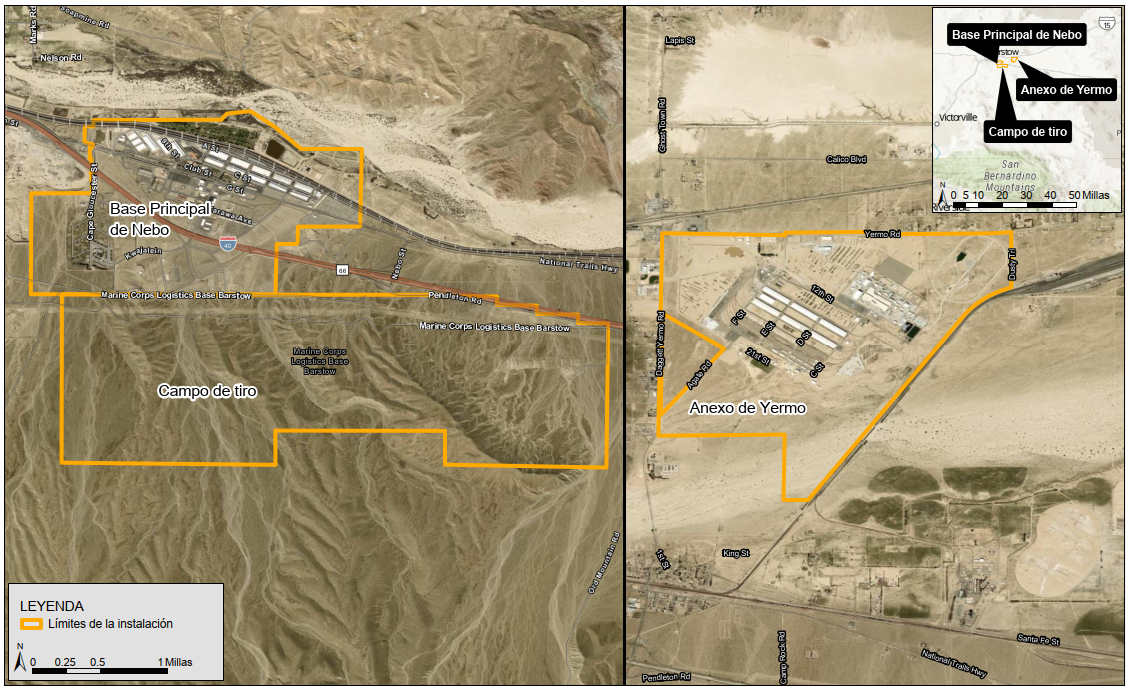
La actividad más común que pudo haber causado emisiones históricasde PFAS al medio ambiente en la MCLB en Barstow (Figura 1) es el uso de espuma contra incendios (específicamente, espuma formadora de película acuosa, o AFFF, por sus siglas en inglés) para pruebas, entrenamiento, extinción de incendios y otras respuestas de emergencia para salvar vidas. Debido a este uso histórico, las PFAS están presentes en las aguas subterráneas de la MCLB en Barstow y pueden estar presentes en pozos de agua potable cercanos situados en la dirección en que las aguas subterráneas fluyen alejándose de la MCLB en Barstow.
FIGURA 1 – MAPA DE UBICACIÓN DE LA BASE
El 26 de abril de 2024, la Agencia de Protección del Medio Ambiente de los Estados Unidos (EPA, por sus siglas en inglés) publicó un Reglamento Nacional Primario de Agua Potable (NPDWR, por sus siglas en inglés) definitivo que establece normas nacionales de agua potable para determinados PFAS en virtud de la Ley de Agua Potable Segura. El reglamento se aplica a los sistemas públicos de agua potable. Los operadores de los sistemas públicos de agua potable regulados por el NPDWR tienen hasta abril de 2029 para cumplir estas normas. En septiembre de 2024, el Departamento de Guerra (DoW, por ssus siglas en inglés) publicó "Priorización de las acciones de limpieza del Departamento de Guerra para aplicar las normas federales de agua potable para sustancias perfluoroalquiladas y polifluoroalquiladas en el marco del Programa de Restauración Ambiental de Defensa", que describe los planes del DoW para incorporar la normativa de agua potable de la EPA en las limpiezas de PFAS en curso del DoW y priorizar las acciones para abordar los pozos privados de agua potable con los niveles más altos de PFAS procedentes de las actividades del DoW. La tabla 1 muestra los niveles que todo el Departamento de Guerra, incluyendo la Marina y la de Infantería de Marina, está autorizado a utilizar para tratar las PFAS en los pozos privados de agua potable.
La tabla 1 presenta los niveles de acción provisionales del Departamento de Guerra (DoW) para las PFAS en pozos privados de agua potable. El memorándum del DoW de septiembre de 2024 se puede consultar aquí.
Tabla 1. Niveles de la NPDWR de la EPA y niveles de acción provisionales del DoW para las PFAS en pozos privados de agua potable
| PFAS |
Niveles de la NPDWR de la EPA
(Pozos públicos) |
Nivel de acción provisional del DoW para las PFAS en pozos de agua potable privados1 |
| ácido perfluorooctanoico (PFOA) |
4 ppt |
12 partes por billón (ppt) |
| ácido perfluorooctano sulfónico (PFOS) |
4 ppt |
12 ppt |
| ácido perfluorononanoico (PFNA) |
10 ppt |
30 ppt |
| ácido perfluorohexano sulfónico (PFHxS) |
10 ppt |
30 ppt |
| ácido dímero de óxido de hexafluoropropileno (HFPO-DA o GenX) |
10 ppt |
30 ppt |
| índice de peligro de una mezcla de al menos dos de PFHxS, PFNA, HFPO-DA y ácido perfluorobutano sulfónico (PFBS) |
1 (sin unidades) |
3 (sin unidades) |
ppt = parte(s) por billón
1Estos niveles se basan en los niveles actuales de la EPA NPDWR. Si la EPA actualiza los requisitos aplicables, el DoW revisará y actualizará su política según corresponda.
Muestreo de pozos privados de agua potable cerca de la MCLB en Barstow
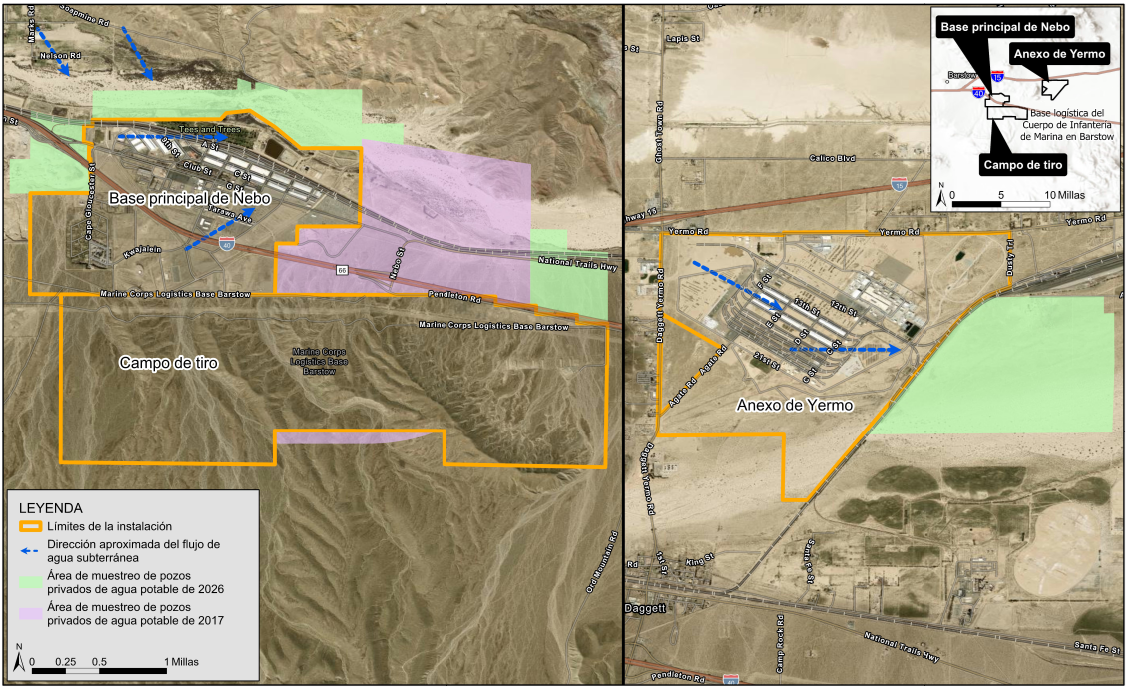
Se han detectado ciertos PFAS en las aguas subterráneas de la MCLB en Barstow y en pozos privados de agua potable (Figura 2) por encima de los niveles de acción provisionales de PFAS del DoW para pozos privados de agua potable. Como resultado, se ha establecido una zona de muestreo a 1 milla en la dirección en la que fluye el agua subterránea desde los lugares donde se han detectado estas sustancias.
En este momento, la Marina y la Infantería de Marina están solicitando permiso a los propietarios para tomar muestras de los pozos de agua potable privados ubicados en las áreas de muestreo (Figura 2). Si su agua potable es suministrada por Golden State Water Company o Daggett Community Services, la Marina y el Cuerpo de Infantería de Marina no necesitan tomar muestras de su agua potable.
FIGURA 2 – ÁREA DE MUESTREO
Acciones Basadas en los Resultados del Muestreo del Agua Potable Privada
Los resultados preliminares del muestreo de pozos privados de agua potable se esperan aproximadamente 30 días después de recoger las muestras. La Marina y el Cuerpo de Infantería de Marina notifica a los propietarios e inquilinos los resultados del agua potable y las medidas de seguimiento, si son necesarias.
La Marina y el Cuerpo de Infantería de Marina abordarán el tema de las PFAS en los pozos privados de agua potable de acuerdo con la política del DoW y la NDAA de 2026:
PFAS en o por encima de los niveles de acciones provisionales de PFAS del Departamento de Guerr para pozos privados de agua potable (Tabla 1). La Marina y el Cuerpo de Infantería de Marina colaborarán con los propietarios para aplicar una solución duradera lo antes posible. Las opciones de soluciones duraderas pueden incluir la conexión al suministro público de agua o la instalación de un sistema de tratamiento de agua potable. Para todos los pozos de agua potable con PFOA y PFOS, individualmente o combinados, por encima de 70 ppt, a Marina y el Cuerpo de Infantería de Marina suministrarán agua embotellada para beber y cocinar a los propietarios o inquilinos hasta que se aplique una solución más duradera.
PFOA y/o PFOS en niveles iguales o superiores a los establecidos por la EPA en la NPDWR (Tabla 1). Cuando los niveles de PFOS y/o PFOA en el agua potable privada superen los niveles establecidos por la EPA en la NPDWR debido exclusivamente a las actividades de la Marina y el Cuerpo de Infantería de Marina en la instalación, la Marina y el Cuerpo de Infantería de Marina ofrecerán una solución duradera para el suministro de agua potable lo antes posible.
Para las medidas correctivas definitivas, la Marina y el Cuerpo de Infantería de Marina reducirán el agua potable a los niveles NPDWR de la EPA o a los niveles de fondo de conformidad con los requisitos de la Ley de responsabilidad, compensación y respuesta ambiental global (CERCLA, por sus siglas en inglés).
Muestreo de pozos privados de agua potable 2017
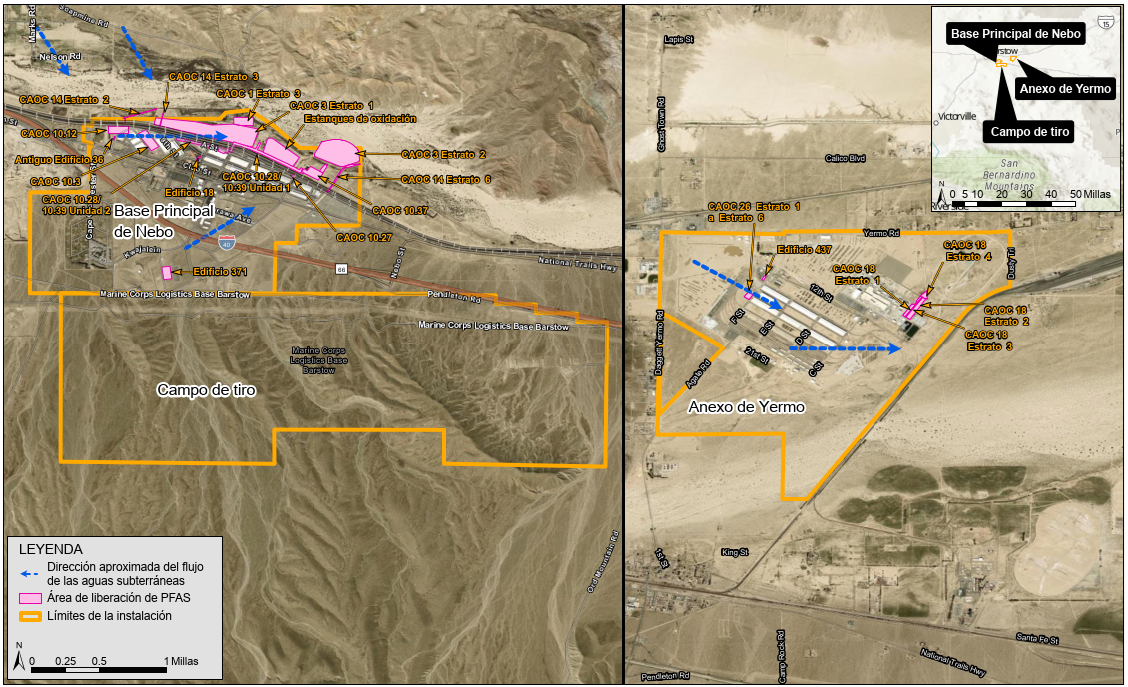
En 2017, la Marina y el Cuerpo de Infantería de Marina tomaron muestras de pozos privados de agua potable basándose en la información disponible en ese momento sobre posibles vertidos de PFAS en la MCLB en Barstow. La zona de muestreo de 2017, que se muestra en la figura 2, se estableció a 1 milla en la dirección en la que fluyen las aguas subterráneas desde las posibles zonas de vertido que se muestran en la figura 3. La tabla 2 ofrece un resumen de los resultados del muestreo. La tabla 3 presenta los resultados de PFAS. Se detectaron concentraciones combinadas de PFOA y PFOS en un pozo por encima de 70 ppt, el nivel de acción del DoW el Cuerpo de Infantería de Marina en ese momento. Como consecuencia, la Marina y el Cuerpo de Infantería de Marina suministraron agua embotellada a la propiedad para beber y cocinar. La Marina y el Cuerpo de Infantería de Marina han reevaluado los resultados de 2017 de los pozos privados de agua potable fuera de la base utilizando los niveles de acción provisionales actuales del DoW para pozos privados de agua potable (tabla 1).
Tabla 2. MCLB en Barstow – Resumen de los resultados de los pozos privados de agua potable de 2017
| Número de pozos muestreados |
Número de pozos muestreados sin detección de PFAS con niveles de acción provisionales del DoW para pozos privados de agua potable |
Número de pozos muestreados con detecciones de PFAS por debajo de los niveles de acción provisionales del DoW para el agua potable privada |
Número de pozos muestreados con detecciones de PFAS en o por encima de los niveles de acción provisional de PFAS del DoW en pozos privados de agua potable |
Número de muestras con detecciones de PFOA y/o PFOS superiores a 70 ppt* |
| 2 |
0 |
0 |
2 |
1 |
*70 ppt para PFOA y PFOS, individualmente o combinados, era el nivel de acción de la Marina y el Cuerpo de Infantería de Marina en el momento de este muestreo.
Tabla 3. MCLB en Barstow: resultados de los pozos privados de agua potable de 2017
| Muestra |
PFOA (ppt) |
PFOS (ppt) |
PFOA + PFOS (ppt)* |
PFNA (ppt) |
PFHxS (ppt) |
HFPO-DA (ppt) |
PFBS (ppt) |
Índice de riesgo** |
| 1 |
ND |
12.5 |
NC |
NA |
NA |
NA |
ND |
NC |
| 2 |
34.8 |
67.9 |
102.7 |
NA |
NA |
NA |
12.5 |
NC |
*El PFOA+PFOS solo se calcula cuando se detectan ambos. La tabla muestra la suma más alta calculada de POA y PFOS y las concentraciones individuales correspondientes de PFOA y PFOS. Para cualquier pozo privado de agua potable con PFOA y/o PFOS, individualmente o combinados, por encima de 70 ppt, la Marina y el Cuerpo de Infantería de Marina pueden proporcionar agua embotellada para beber y cocinar hasta que se implemente una solución más duradera.
** El índice de peligro se calcula para HFPO-DA, PFBS, PFNA y PFHxS cuando se detectan dos o más de estos compuestos en la muestra. La tabla 3 muestra el HI más alto calculado junto con los resultados correspondientes de PFNA, PFHxS, HFPO-DA y PFBS para cada fuente de agua potable muestreada. Calculado según las recomendaciones de la USEPA (Objetivos de nivel máximo de contaminantes [MCLG] para tres sustancias perfluoroalquílicas y polifluoroalquílicas [PFAS] individuales y una mezcla de cuatro PFAS, 2024) de la siguiente manera:
| Índice de peligro (sin unidades) = |
HPFO-DA (ppt) + |
PFBS (ppt) + |
PFNA (ppt) + |
PFHxS (ppt) |
| 10 (ppt) |
2000 (ppt) |
10 (ppt) |
10 (ppt) |
J = analito identificado positivamente, pero el valor indicado es aproximado.
NA = no analizado
NC = no calculado
ND = no detectado
ppt = partes por billón
Identificación de emisiones de PFAS en MCLB en Barstow
En 2019 se finalizó una evaluación preliminar (PA, por sus siglas en inglés) de PFAS (MMEC 2019) que identificó las áreas en las que podrían haberse producido emisiones de PFAS. A partir de los resultados de la PA de PFAS, se completó una inspección del sitio (SI, por sus siglas en inglés) de PFAS 2019 (Brady GCE 2019). Entre octubre y diciembre de 2018 se llevaron a cabo la recogida de muestras y el análisis de las aguas subterráneas, los sedimentos y el suelo. Se encontraron PFAS en las aguas subterráneas y el suelo de la MCLB en Barstow. Los emplazamientos de PFAS investigados en la MCLB de Barstow se enumeran a continuación y se muestran en la figura 3. Se están llevando a cabo investigaciones de remediación en las siguientes áreas de vertido:
| CAOC/Edificio |
Descripción |
| Base principal de Nebo |
| CAOC 10.27 |
Edificio S-338 |
| CAOC 14 Estrato 6 |
Canal de drenaje F |
| CAOC 1 Estrato 3 |
Área de eliminación de lodos |
| CAOC 3 Estrato 1 |
Campo de golf |
| CAOC 3 Estrato 2 |
Estanques de eliminación y área de desbordamiento |
| CAOC 10.37 |
Antigua planta de tratamiento de aguas residuales industriales (IWTPpor sus siglas en inglés) |
| CAOC 10.38/10.39 Unidad 1 |
Líneas de recogida de aguas residuales domésticas e industriales |
| CAOC 10.38/10.39 Unidad 2 |
Líneas de recogida de aguas residuales domésticas e industriales |
| Estanques de oxidación |
Estanques de oxidación |
| CAOC 10.3 |
Almacén 2 |
| CAOC 10.12 |
Edificio 50 |
| CAOC 14 Estrato 2 |
Desagüe B del lecho del río Mojave |
| CAOC 14 Estrato 3 |
Desagüe C del lecho del río Mojave |
| Antiguo edificio 36 |
Laboratorio de procesamiento fotográfico |
| Edificio 18 |
Estación de bomberos |
| Edificio 371 |
Área actual de entrenamiento contra incendios (FTA, por sus siglas en inglés) |
| Anexo Yermo |
| CAOC 18 Estrato 1 |
Orilla oeste |
| CAOC 18 Estrato 2 |
Canal de drenaje |
| CAOC 18 Estrato 3 |
Orilla este |
| CAOC 18 Estrato 4 |
Desagüe al norte de CAOC 18 |
| CAOC 26 Estrato 1 |
Estante de limpieza a vapor Separador de aceite/agua y zanja de drenaje |
| CAOC 26 Estrato 2 |
Área oscurecida |
| CAOC 26 Estrato 3 |
Área perimetral |
| CAOC 26 Estrato 4 |
Tanque de almacenamiento subterráneo T-533 (drenaje francés) |
| CAOC 26 Estrato 5 |
Sumidero |
| CAOC 26 Estrato 6 |
Área de la plataforma del transformador |
| Edificio 437 |
Estación de bomberos |
La Marina y el Cuerpo de Infantería de Marina continuarán investigando las PFAS en MCLB Barstow siguiendo el proceso de la Ley de Respuesta Ambiental Integral, Compensación y Responsabilidad (CERCLA, por sus siglas en inglés) y evaluarán si es necesario tomar medidas. Para obtener más información sobre todas las investigaciones ambientales en MCLB en Barstow, visite https://go.usa.gov/xShC7.
Figura 3 – ÁREAS DE VERTIDO DE PFAS
Documentos de muestreo de pozos privados de agua potable de la MCLB en Barstow
Enlaces