NSN Environmental Restoration Program
In 1975, the Department of Defense began a program to assess past hazardous and toxic materials storage and disposal activities at military installations. The goals of this program, referred to as the Environmental Restoration Program (ERP), were to identify environmental contamination resulting from past hazardous materials management practices, to assess the impacts of the contamination on public health and the environment, and to provide corrective measures as required to mitigate adverse impacts.
In 1980, Comprehensive Environmental Response, Compensation, and Liability Act (CERCLA), or “Superfund,” was passed to investigate and remediate areas resulting from past hazardous waste management practices. This program is administered by the United States Environmental Protection Agency (USEPA) or state agencies. Naval Station Norfolk (NSN) was added to the CERCLA National Priority List (NPL) of Superfund sites on April 1, 1997. At the time of the NPL listing, Naval Support Activity (NSA) Hampton Roads was a part of NSN. Under the NPL, all decision documents associated with site investigation and environmental cleanup is approved by the Navy and USEPA with concurrence by Virginia Department of Environmental Quality (VDEQ) who comprise the NSN ERP Partnering Team. Based on the results from desktop audits, site investigations, and/or removal actions, 96 sites have been identified for no further action by the NSN Environmental Restoration Program (ERP) Partnering Team.
In September 2010, the U.S. Navy, in collaboration with USEPA and VDEQ, designated NSN as construction complete under the NPL. This designation is achieved when physical construction of all cleanup actions is complete, all immediate threats have been addressed and all long-term threats are under control for all portions of the site. Although remedy construction has been completed, the cleanup is ongoing at seven sites at NSN and two sites at NSA Hampton Roads. The Navy inspects the sites regularly to ensure that cleanups conducted remain protective of public health and the environment. The status of the cleanup at the nine sites is updated in an annual Site Management Plan. Click on the links below to view the Site Management Plan and a Fact Sheet providing an overview of the ERP at NSN and NSA Hampton Roads:
This web site is part of the U.S. Navy's active efforts to provide accurate, timely and comprehensive information on the ERP currently in action at NSN and NSA Hampton Roads, Norfolk, Virginia.
Facility Location and Physical Description
NSN is the largest naval base in the United States, and is situated on 4,631 acres of land in the northwestern portion of Norfolk, Virginia. NSN is bordered on the north by Willoughby Bay, on the west by the confluence of the Elizabeth and James rivers, on the east by the City of Norfolk, and on the south by NSA Hampton Roads by the City of Norfolk. A portion of NSN’s eastern boundary is also formed by Mason Creek. NSN includes approximately 4,000 buildings, 20 piers, and an airfield. The western portion of NSN is a developed waterfront area containing the piers and facilities for loading, unloading, and servicing naval vessels. Land use in the surrounding area is commercial, industrial, and residential. The waterfront area south of NSN provides shipping facilities and a network of rail lines for several large industries. Residential and recreational areas border NSN at the Base’s southern, eastern, and northeastern boundaries.
NSA Hampton Roads is located along the southern border of NSN and encompasses just under 800 acres. NSA Hampton Roads is bordered to the north and east by NSN or the City of Norfolk, to the south by the City of Norfolk, and to the west by the City of Norfolk and the Supply Depot Annex.
Figure 1 - Base Map with Site Locations (Click on image below to open a larger PDF version) 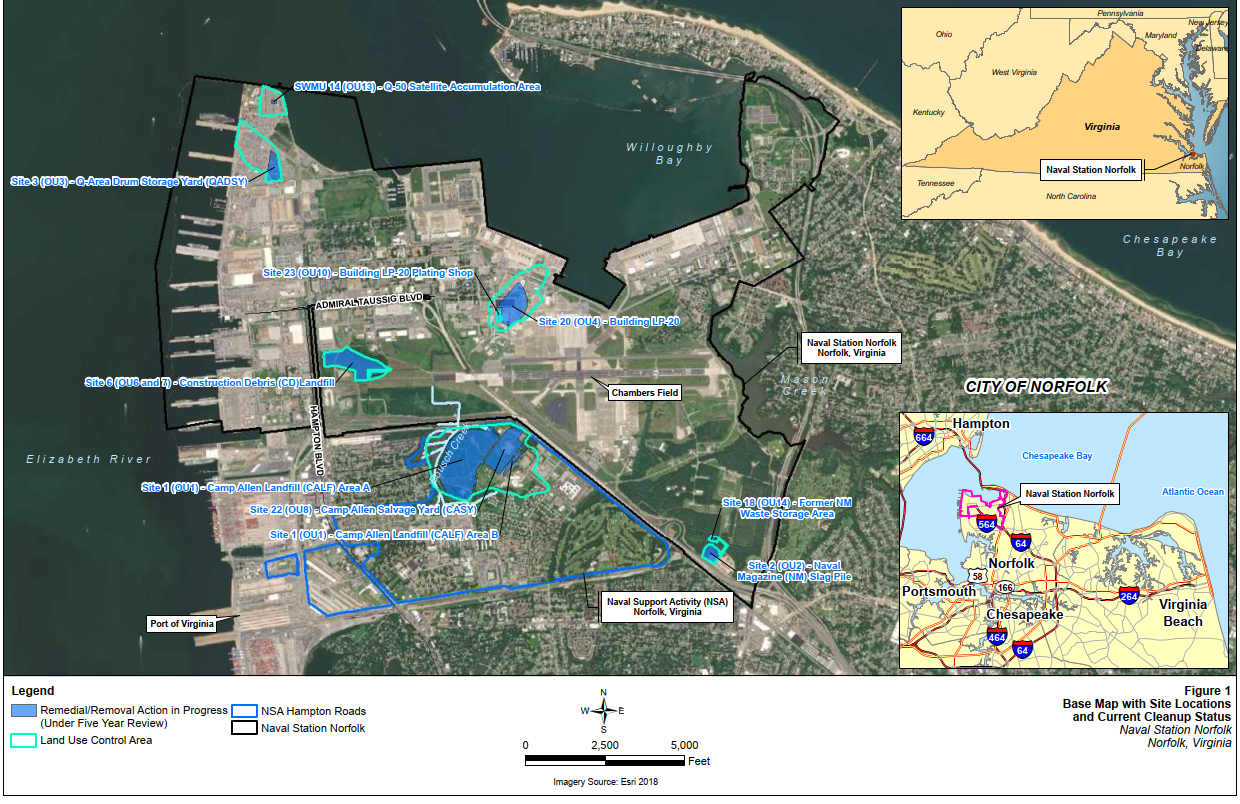
Facility History and Mission
NSN began operations in 1917, when the Navy acquired 474 acres of land to develop a naval base to support World War I activities. Bulkheads were built along the coast to extend available land, and after extensive dredge and fill operations the total land under Navy control was 792 acres. An additional 143 acres of land were acquired in 1918 and officially commissioned as Naval Air Station Norfolk. Improvements to the piers and expansion of supply and material handling facilities were also completed between 1936 and 1941.
During World War II, major construction projects were completed, consisting of a power plant, numerous runways and hangars, a tank farm, several barracks, and housing complexes. During this time, the area of NSN expanded to more than 2,100 acres. After World War II, NSN continued to acquire land through various types of land transfers and dredge and fill operations conducted in areas of Mason Creek, Bousch Creek basins, and Willoughby Bay.
During its history, NSN has expanded to become the world’s largest naval installation, with approximately 105 ships homeported at the Base. NSN currently has 14 piers handling approximately 3,100 ship movements annually. The mission of NSN is to provide fleet support and readiness for the United States Atlantic Fleet.
NSA Hampton Roads, which was originally named the Flag Administrative Unit, separated from NSN in 1948 and adopted its current name in 2011. Since its inception, NSA Hampton Roads has become a major Navy command with the responsibilities as the Installation Commander for three base installations and as the Program Director for Regional Support Services. The mission of NSA Hampton Roads is to enable robust command and control for Navy, Marine Corps, Coast Guard, NATO and interagency units; provide premier training and operational facilities and ranges to sustain generation activities; support warfighters with world-class medical, family support and recreational facilities and services; and enhance relationships with community partners in Norfolk, Portsmouth, and North Carolina.
Operations and Process Descriptions
NSN operates in various capacities to provide support to vessels, aircraft, and other activities. NSN houses many tenants, each performing different operations involving the servicing and maintenance of vessels and aircraft.
The service and maintenance of vessels includes utilities hookups, onboard maintenance, and coordination of ship movements in the harbor. Additional functions include loading, unloading, and handling of fuels and oils used aboard the vessels. Ship and aircraft repair operations consist of paint stripping, patching, parts cleaning, repainting, engine overhauls, sandblasting, and metal-plating processes.
NSA Hampton Roads seats more than 6,000 personnel and includes facilities for fleet headquarters administrative and communication operations as well as the U.S. Fleet Forces Command; Joint Staff Hampton Roads; U.S. Marine Corps Forces Command; Naval Submarine Forces, Atlantic; and Naval Reserves Forces Command.